Blog

  • Graha Upaya: Remedies for Planets & Planetary Magick

    Graha Upaya: Remedies for Planets & Planetary Magick

    Jyotish Vidya describes (what we call the Planets) Graha – one who seizes the energy.

    “Brihat Jatak” by Acharya Varahamihira, details the colors of the planets:

    रक्त श्यामो भास्करो गौरेन्दुर्नात्युच्चाङ्गो रक्त गौरश्च वक्रः ।
    दूर्वा श्यामो ज्ञो गुरुर्गौरगात्रः श्यामः शुक्रो भास्करिः कृष्णदेहः ॥ ४ ॥

    rakta śyāmo bhāskaro gaurendurnātyuccāṅgo rakta gauraśca vakraḥ |
    dūrvā śyāmo jño gururgauragātraḥ śyāmaḥ śukro bhāskariḥ kṛṣṇadehaḥ
     || 4 ||

    Sun is Dark Red in Color

    Moon is White

    Mars colors are Red and White

    Mercury is dark colored Durva grass

    Jupiter is yellow colored

    Venus is Dark blue

    Saturn is Black

    (Note: A simplified translation)

    You will find a few variations in the colors of the planets… Most texts will give Venus the color white and Saturn dark blue.

    The Brihat Samhita mentions the following on Gems and Upaya:

    “According to some, gems are the bones of Balāsura and according to others, they are the bones of the Sage Dadhīci. In the opinion of some, gems are various sorts of stones which naturally exist in the earth.

    Twenty-two different sorts of gems (ratna) are mentioned. These are—Diamond, Sapphire, Emerald, Agate, Ruby, Blood-stone, Beryl, Amethyst, Vimalaka, Quartz, Crystal, Moon-stone, Saugandhika (a type of Ruby ), Opal, Conch-shell, Azure-stone, Topaz, Brahmamaṇi, Jyotīrasa, Sasyaka (blue vitriol Copper Sulfate), Pearl and Coral.”

    In various tantric and natural indigenous paths, bones, hide and teeth of animals are used in medicine pouches and amulets. It is not random – usually given by shaman or other healer for specific use charged on an intentionally chosen lunation, based on the nature of the working etc.

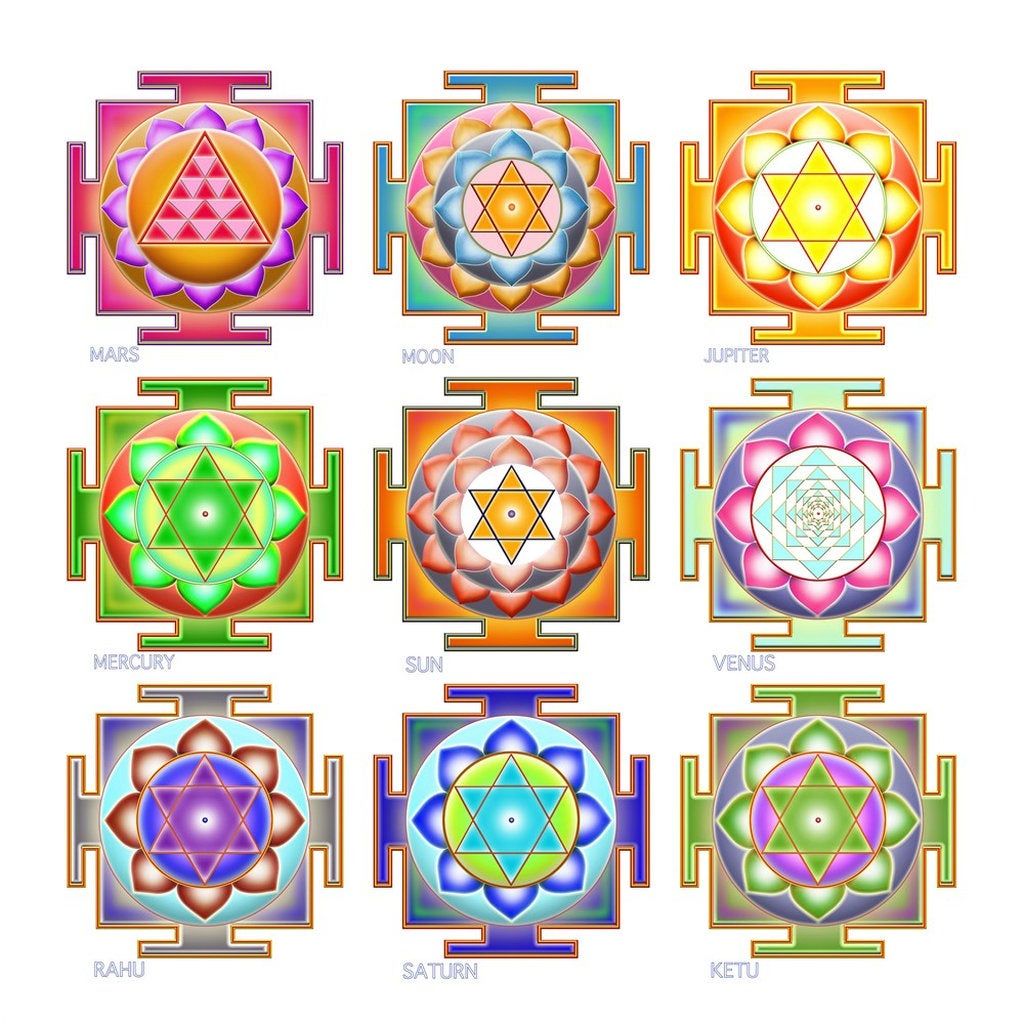
    The Yantras of the Grahas also give us a color palette to harmonize the energy of each Graha. Below is one example.

    Grahas are also associated with the days of the week, and Lord one hour per day and night (changing daily according to the Lord of the day – Varesh). The Vedic week begins with Sunday and ends with Saturn-day.

    Sunday – Ravivar – Lord is Surya (Sun)

    Monday – Somvar – Lord is Chandra (Moon)

    Tuesday – Mangalvar – Lord is Mangal (Mars) said to be co-ruled by Ketu (South Node of the Moon)after dark

    Wednesday – Budhavar – Lord is Budha (Mercury)

    Thursday – Guruvar – Lord is Brihaspati or Guru (Jupiter)

    Friday – Shukravar – Lord is Shukra (Venus) said to be co-ruled by Rahu (North node of the Moon) after dark

    Saturday – Shanivar – Lord is Shani (Saturn)

    When creating planetary magic using colors its important to consider the day of the Planet whose energy you want to work with along with the colors and tattvas (elements). By incorporation of various colors intentionally you are creating an energy field around yourself using the most available everyday items: clothing! This is a great remedy that anyone can try to harmonize transits, malefic combinations etc.

    Simple chant to the Trimurti+Devi and Navgraha:

    Brahma Murari Tripuratakari

    Bhanu Sasi Budhasca Shukraha

    Shani Rahu Ketva

    Bhagavati Kali

  • Pratyahara

    Pratyahara

    The Yoga Sutras of Patanjali instructs the seeker on the 8 Limbs of Yoga, Pratyahara being the 5th, elaborated on in Sutras 2.54-2.55:

    स्वविषयासंप्रयोगे चित्तस्य स्वरूपानुकारैवेन्द्रियाणां प्रत्याहारः ॥५४॥

    sva vishaya asamprayoge chittasya svarupe anukarah iva indriyanam pratyaharah

    By turning attention within (pratyahara), consciousness ceases to come in contact with the objects of the senses. It then mirrors one’s essential nature.

    ततः परमावश्यता इन्द्रियाणाम् ॥५५॥

    tatah parama vashyata indriyanam

    From the practice of pratyahara comes supreme mastery of the senses.

    from “Yoga and Ayurveda” by David Frawley

    Prati – against, away

    Ahara – food

    Pratyahara is the control of ahara, gaining mastery over external influences

    3 Levels of Ahara:

    1. Physical food -nourishes the body and the elements
    2. Impressions – nourish mind
    3. Associations – people that nourish the soul

    Pratyahara is twofold.

    It involves withdrawal from wrong food, wrong impressions and wrong associations, while simultaneously opening up to right food, right impressions and right associations.

    We cannot control our mental impressions without right diet and right relationship, but pratyahara’s primary importance lies in control of sensory impressions which frees the mind to move within. By withdrawing our awareness from negative impressions, pratyahara strengthens the mind’s powers of immunity. Just as a healthy body can resist toxins and pathogens, a healthy mind can ward off the negative sensory influences around it.

    4 Types of Pratyahara:

    1. Indriya Pratyahara – sense control
    2. Prana Pratyahara – prana control
    3. Karma Pratyahara – action control
    4. Mano Pratyahara – withdrawal of the mind from the senses

    Pratyahara centers on the right intake of impressions.

    In Pratyahara we withdraw our attention from ordinary distractions

  • Hastamalaka & The State of Realization

    Hastamalaka & The State of Realization

    *excerpt from “Hastamalaka Stotram of Adi Shankaracharya: A contemplation by Swami Purushottamananda” an English translation of Sant Eknath of Maharashtra’s original commentary in Marathi

    What is that which complete in itself can unfold happiness?

    Vedantic Masters refer to it as the ‘Supreme Being” or Sat-Chit-Ananda (Atman). Though ever-accomplished, for the individual (jiva) it appears to be hidden due to ignorance of the Self (avidya). It can be revealed only by Self-knowledge in the pure heart. That state is liberation, Kaivalyam. The Upanishads also declare: ‘Mukti is through knowledge alone’ (jnananad evatu kaivalyam).

    Karma performed without any selfish motive and with an attitude of surrender unto the Lord, brings about purification of the heart and makes it eligible for knowledge of the Self. Such a seeker of knowledge, with pure mind-intellect (heart), gains this knowledge through a study of the scriptures with the grace and blessings of the Guru.

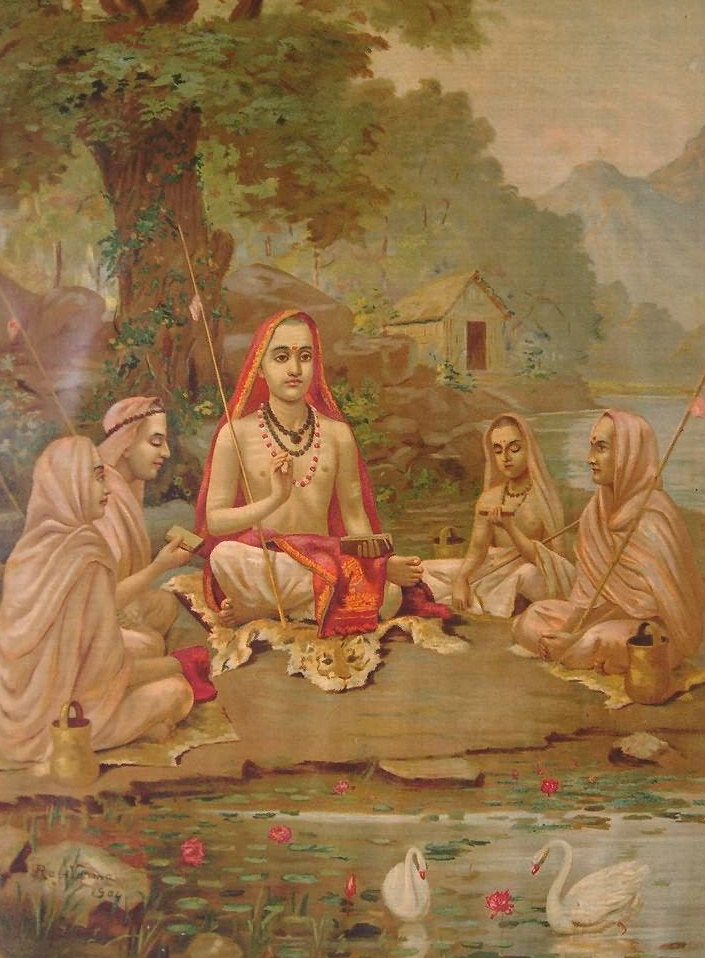
    Hastamalaka, one of the four renowned disciples of Bhagavan Adi Shankaracharya, was such a realised soul, established in the bliss of perfection. As a child, he did not talk to anyone, including his parents. His behavior was like that of ‘Jada Bharata’. There is a story about him…

    Once upon a time, a Siddha Mahapurusha lived on the banks of a river. One day, a lady came to him with a small child in her arms. She requested the Mahatma to look after the baby and went to the river to bathe. Soon after, when the Mahatma was lost in samadhi, the child crawled to the river, slipped into it and died. The dead body of the child came up, floating on the water in the arms of the mother. Terribly shocked to see her baby dead, she brought the dead body to the Mahatma. Hearing her heart-rending cry, he opened his eyes and was moved by her grief. In his infinite compassion, by his yogic powers, he left his own body and entered the dead body of the boy. Thus, there was a realised soul in the form of the child.

    Revelling in Self-Joy (svananda), the child remained in silence (maunam). He neither talked to anyone nor wept like a normal child. As a result, his parents and other people considered him to be insane, dull-witted, deaf and dumb, and so on. The parents were doubtful about performing his thread ceremony, as he would not chant the Gayatri Mantra.

    Fortunately, at that time, Bhagavan Adi Shankaraacharya, on his visit to the famous Mookambika Temple came to the nearby village Sribali. Since the parents were worried about the child, they brought him to the Acarya to receive his blessings. The Acarya was highly pleased to see the signs of Self-Realisation in him.

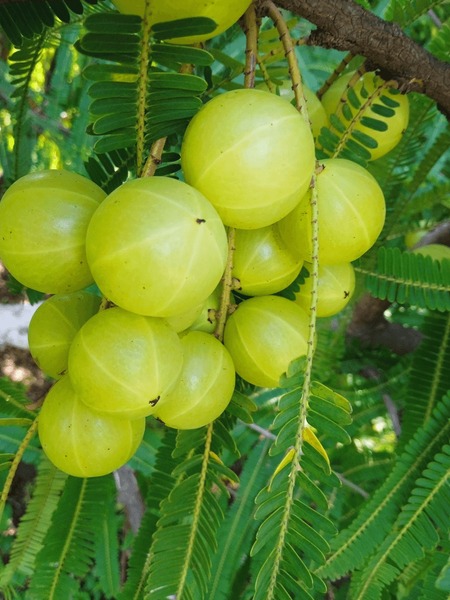
    His state of realisation was as clear as an amalaka fruit kept on the palm, so the Acarya called him Hastamalaka (Hasta means ‘hand’ , amalaka means ‘gooseberry’) and for the benefit of seekers, compiled the conversation in a composition called Hastamalakiyam or Hastamalaka Stotram.

    Hastamalaka Uvaca-

    naham manusyo na ca devayaksau

    na brahmanaksatriyavaisyasudrah

    na brahmacari na grhi vanastho

    bhiksurna caham nija bodharupah

    Hastamalaka replies:

    I am not a man, not even a deva (God) or a yaksha (semi-celestial being), not brahmin-kshatriya-vaishya-sudra, nota brahmachari (student), not a householder, not a forest-dweller (retired person), not even a mendicant (sanyasi), I am the nature of Self-Knowledge.

    Nimmittam manascaksuradripravarttau

    nirastakhilodhirakasakalpah

    ravirlokacestanumittam yatha yah

    sa nityapalabdhisvarupo’hamtma

    Who is the cause for the activities of the mind and eyes, is devoid of all limiting adjuncts, like space, just as the sun is the cause for all worldly activities (but is the witness), I am of the nature of that ever-existing Atman. That, which is the cause for the activities of the mind and eyes.

    This is the declaration of Vedanta.

    The play of names and forms (prapancha/samsara) which appears to be real, is proved to be an illusion from the standpoint of the Self, which alone was, is, and shall remain forever unchanged, like a screen on which pictures are projected.

    One who has realized this, understands that though he is in the body, he is beyond it.

    When the sun rise, darkness vanishes on its own. Similarly, in the light of knowledge of the Self, ignorance, with all its paraphernalia, is removed. In the state of unconditioned bliss of the Self, jiva the experiencer dissolves, along with its conditioning. There is no one left other than the Self to describe the experience of the the Self.

    Thus, with the example of the sun, the nature of the eternal Self is indicated as an unconditioned witness, free from the sense of doer-ship and enjoyer-ship.

    These powerful pointers to the Self in fourteen verses provide us great insight into the illusory nature of all our conflicts and to the ever-present Freedom within us.

    Om Shanti! Shanti! Shanti!

  • Tradition, Yoga, Tantra + Kali

    Tradition, Yoga, Tantra + Kali

    excerpts from “Biography of a Russian Yogi: The Extraordinary story of Yogi Matsyendranath” by Keith Simons

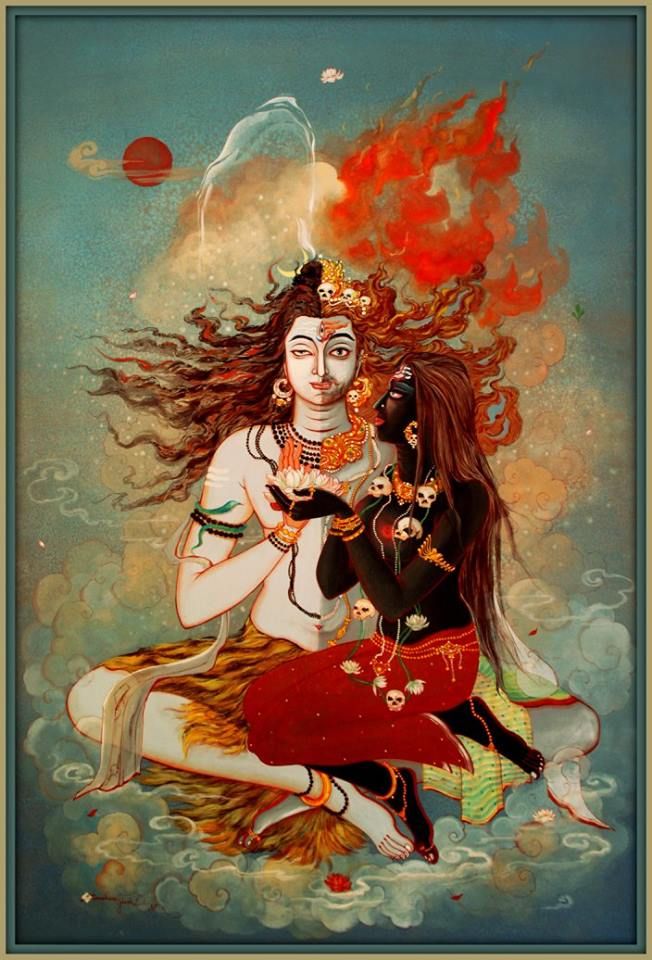
    “My tradition originated in North India and is related to Tantra, like Kundalini and Shakti. In my thinking yoga is the essence of Tantra. Yoga is therefore related to inner processes. To be successful in yoga it helps if you understand the essence of Tantra, because yoga appeared in an environment of Tantra. Of course there are many different types of yoga nowadays. Yoga is now everywhere but mostly non-traditional. Kundalini is energy in our bodies and an aspect of universal power, the mother of the universe. In Tantra there is worship of the Goddess and an understanding of how she developed consciousness, and is therefore a personification of supreme wisdom. She needs a partner and that is Shiva. So Yoga and Tantra are focused on the union of Shakti and Shiva. This is just a brief introduction.

    Kali … is related to time. Time is always moving and changing. Her color is black and this is associated with death. With time we age and finally we leave this world.

    Symbolically Kali kills demons and is concerned with removing our anger, envy and other weaknesses, and finally she leads us to enlightenment.

    Kali is like the night time when you can see the stars in the sky, where everything dissolves. Darkness is then primordial reality in which all matter appears, such as galaxies and planets including our world. “

  • The Role of Vedic Texts as Guidelines to Overcome Fear, Anxiety, & Depression And Their Role in Inspiring Well-Being & Individual Growth

    The Role of Vedic Texts as Guidelines to Overcome Fear, Anxiety, & Depression And Their Role in Inspiring Well-Being & Individual Growth

    This is my contribution to the publication by ICVP for 2024 International Conference on Vedic Psychology, a conference dedicated to the study and promotion of the study of psychology as outlined in the Vedic texts.

    ABSTRACT
    The Bhagavad Gita, Ramayan, Upanishads, Vedas and other texts from Bharat are not merely “stories” or historical accounts. Among certain circles of modern scholars, they are colloquially known as Itihasa because these historical epics also correspond to astronomical events and include coded information to be revealed by meditation on the content. Itihasa includes the epic texts like
    the Ramayana and the Mahabharata, which cover important events, ethical guidelines, and moral teachings. These narratives often combine historical accounts with mythological themes, serving both as literary guides and spiritual guides(Wisdom Library 2025). These texts were written by
    sages and rishis in a specific poetic meter called Chanda, which itself is the “feet” of the Veda Purusha, the Cosmic being. The rishis used storytelling as a form of teaching students not only life lessons, but valuable information that aimed to awaken the student on the path of self-realization. The sciences of Ayurveda, Jyotish, yoga and were integral parts of everyday life thousands of years ago, when humans were more connected to nature and methods of self-care like dinacharya (daily routine) and ritucharya (seasonal adjustments to daily life) were commonly practiced.

    Over time as “modernity” became popularized and people lost touch with nature, the intelligence of the Vedic Scriptures was written off as “stories” and relegated to out-of-touch fictional status. Now we find ourselves at an interesting turning point: rediscovery and a new appreciation of the original complete systems of Bharat to solve the most common real-life modern problems of fear, anxiety and depression.
    Keywords: Anxiety, depression, fear, Itihasa, Bhagavad Gita, Upanishads

    The Nature of Mind
    Mind is universal, atomic or indivisible, and not directly perceivable. Mind directs experience. It is awareness of an object or goal and then perceives the outer object. (Lad, 2002, 16) One of the most studied and “mysterious” aspects of human incarnation is the nature of the Manas (mind). In order to understand the mind better, let’s explore how Ayurveda approaches the subject of
    functionality and the 5 Kleshas impact on the different parts of the brain. Prana vayu, sadhaka pitta and tarpaka kapha are key players in brain function. Ayurveda considers the heart to be the seat of the mind; it is also the location of vyana vayu, which is responsible for the circulation, pulses and throbbing impulses in the body. Prana, the neuro-electrical impulses moving through the nerves, delivers messages to and from the brain and from the DNA to the RNA, where past memories and experiences are recorded. Sadhaka Pitta, present in grey matter in the brain and the heart, is responsible for conscious thinking, emotions, recording the experiences in the brain which become memories, and transforming sound into nerve impulses which become feelings and emotions; creating the feeling that “I exist”. Tarpaka kapha, the white film over the brain, records the visual, olfactory and tactile experiences. (Lad, 2002, 59-60)

    Five afflictions (Kleshas) to the Manas according to Sage Patanjali: Avidya (ignorance), asmita (egoism), raga (desire), dvesha (aversion), and abhinivesha (will to live) affect the intellectual, emotional and instinctive mind, impacting different parts of the brain. Avidya and asmita affect the front brain, considered the “seat of logic”. Raga and dvesa affect the hypothalamus, the base
    of the brain where the sensations of pleasure and pain are imprinted. Abhinivesha affects the unconscious mind or back brain, “the seat of reason” which is the location of samskaras “past impressions”. (Iyengar, 1993, 105)

    Ayurveda teaches that Manas has its own Prakriti which is influenced by the foods we eat, sensory experiences and by the mental state of the parents at the time of conception. The manas prakriti is developed in the third month of pregnancy, along with the heart. Manas Prakriti can be changed through the practices of yoga, meditation and spiritual guidance by a mentor or Guru.
    When a man finds his existence and unity in the self- who is the basis of life, who is beyond the senses, who is formless, inexpressible, beyond all the predicates – then alone does he transcend fear. (Prabhavananda, 1957, 56)

    Creating the Foundation for a Healthy Life
    The nature of mind is one concept that has been pursued since time immemorial in the East, but here in the West, we are in the early stages of truly understanding this phenomenon due to the cultural rejection of “esoteric” subjects in favor of social status and wealth accumulation. In the pursuit of wealth accumulation, many get trapped into long hours at work and less hours at home, neglecting Dinacharya (daily health routine). The way that most modern societies operate, leave little time for the everyday person to factor in Dinacharya. More concerning, there is a lack of acknowledgement of a need for spiritual and mental cleanliness: making it very easy for most people to neglect this aspect of their existence, thus creating a fertile breeding ground for
    psychological and health imbalances. Psychological problems arise ultimately from a misapplication of the energy of consciousness and lack of proper guidance.

    Ayurvedic psychology emphasizes right association to ensure psychological well-being. We should always be careful to keep ourselves in the right company. We should seek the good and strive to be in the company of the wise. In turn, we ourselves should strive to have a beneficial influence on others. Healing the mind involves healing how we relate to the world. It means establishing a society or a group of friends that draws us upward. (Frawley 1997, 152-153)

    The practice of Yoga, or inner integration, reverses all psychological problems by merging the mind back into its immutable source of pure consciousness, in which resides perfect peace. For this reason, Yoga is an integral part of Ayurveda, the science of life, particularly for treating psychological disorders. (Frawley, 1997, 259) The Vedic lifestyle includes philosophy, health guidelines, and common sense approaches that defy time and space. This is why more professionals are borrowing many of the basic tenets of Yoga, Ayurveda and Jyotish shastra to integrate into “modern” holistic healing modalities aimed at the Western audience. To create a solid foundation for a lifetime of health, we can begin with the Ashtanga Yoga (Eight Limbs of Yoga): Yama – Rules of social conduct, Niyama – Rules of personal conduct, Asana – Physical postures: right orientation of the physical body, Pranayama – Breath control: right use of pranic force, Pratyahara – control of the mind and senses, Dharana – Concentration: control of attention, Dhyana – Meditation: right reflection, and Samadhi – Absorption: union. Once the foundation is strong, then a personalized Sadhana and health regimen can be added to sustain the Rogi. According to the Mimamsa Philosophy, (mimamsa- analyze thoroughly and understand the truth) to understand our individuality, to truly know ourselves is to know God. God is reflected in all beings in two forms: Jivatman, all the living beings on the earth plane, and Paramatman, the eternal cosmic self. The process of meditation aims to unite and harmonize these two energies. (Lad, 2002,18-19 )

    Ayurvedic Psychology & Counseling: Modern Application of an Ancient System
    Ayurvedic psychology reflects the views of mind and consciousness found in Samkhya, Yoga and Vedanta and their focus on the Purusha and Atman (higher Self of pure consciousness). It includes descriptions of the mind and its different designations and functions (chitta, buddhi, manas, ahamkara or memory, intelligence, thought and ego) and the place of the five koshas or layers of
    the individual soul (ananda or bliss, vijnana or experiential wisdom, manas or sensory mind, prana or vital energy, and anna or food), holding our karmic patterns from one birth to another. Vedic teachings do not merely look at the human mind and physical reality but extend their inner study
    to the Self behind the universe, affording a cosmic dimension to their orientation. (Shastri, 2022)

    The distinction between eastern and western psychological counseling systems can be made through evaluation of the type of problem-solving method, plan of action and course of treatment. Vedic counseling utilizes the holistic system of Ayurveda to assess the mind, body and spiritual health along with the Vedic texts as a basis for a plan of action to improve the condition of the Rogi. The Western methods use a conversational analysis (based mostly on Freudian/Jungian psychology), medication as a main source of treatment, diet and lifestyle are rarely considered. When there is no clear course of action or goal to eliminate the problem, the suffering of the Rogi cannot be properly identified or treated successfully, especially if the whole being is not considered.

    Vedic Counseling addresses the whole life of a person, including the nature of consciousness, mind, Self, karma and rebirth as addressed in Yoga and Vedanta. It extends to all the domains of life, including career, creative expression, relationship, family issues and finances as well as yogic spirituality. Vedic counseling is primarily a psychological approach and the foundation for Vedic psychology. (Shastri, 2022)

    Since 2020, there has been public demand for more natural, indigenous, tribal and folk medical systems to be accepted into mainstream health and education. This comes as the results of the pandemic continue to bring suffering in the forms of disease, vaccine injuries, turbo cancers, anxiety, depression, suicide and death. One of the positive outcomes of this crisis has been a resurgence in spirituality, cultivation of self knowledge – Adhyatmika, and maintaining a
    connection with nature. The goal of life has been described by countless sages as Nisreyasa – freedom from consciousness, matter and attainment of bliss.

    Vedic Texts as Psycho-Spiritual Guides: Lessons from the Bhagavad Gita, Upanishads and the Mahabharata
    The Bhagavad Gita, probably the most well-known of the Vedic Scriptures outside of India, is usually one of the first texts that Westerners can easily access due to its almost “pop-culture” status and popularity among self-help and new age circles. The ability of the reader to relate to the dilemmas faced by Arjuna, the great warrior, makes this Ithihasa one of the most consulted texts
    by seekers of all ages and faiths. It is the age old existential crisis of duty, finding one’s power and place in society and the realization of destiny.

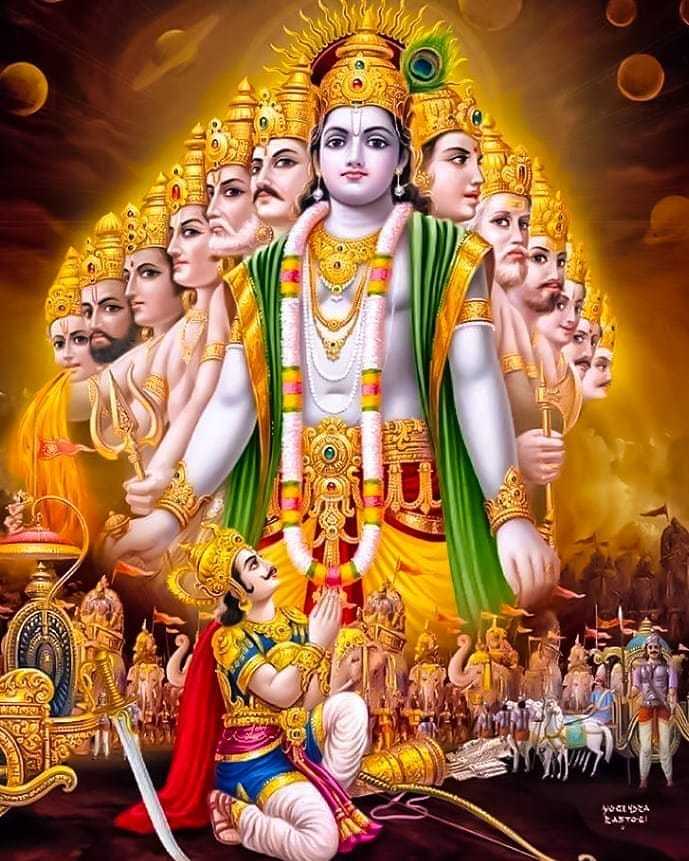
    Arjuna asks Lord Krishna to describe the qualities of one who has transcended the influence of the material plane and how he can attain this state. Lord Krishna responds: O son of Pāṇḍu, he who does not hate illumination, attachment and delusion when they are present or long for them when
    they disappear; who is unwavering and undisturbed through all these reactions of the material qualities, remaining neutral and transcendental, knowing that the modes alone are active; who is situated in the self and regards alike happiness and distress; who looks upon a lump of earth, a stone and a piece of gold with an equal eye; who is equal toward the desirable and the undesirable; who is steady, situated equally well in praise and blame, honor and dishonor;
    who treats alike both friend and enemy; and who has renounced all material activities – such a person is said to have transcended the modes of nature.
    (Bhaktivedanta Book Trust International, Inc., 1972)

    In the Taittiriya Upanishads, there is a dialogue between Brighu and his father Varuna on the nature of Brahman. Varuna explained the physical sheath and the vital sheath and the functions of the senses saying, “He from whom all beings are born, in whom they live, being born, and to whom at death they return – seek to know him. He is Brahman.” Brighu practiced austerities and meditation, coming to different conclusions: Brahman is food, Brahman is primal energy, Brahman is mind, Brahman is intellect and finally Brahman is joy. Brahman is to be meditated upon as the source of all thought, life and action. He is the splendor in wealth, the light in the stars. He is all things. Let a man meditate on Brahman as support, and he will be supported (Prabhavananda, 1957, 58)

    In the Puranas and Ithihasa, demonstrations of revival with herbs and rituals for purification are detailed to educate the listener/reader on how to solve situations with plants and various substances. In Valmiki’s Epic “Ramayan”, there is a famous scene where an Ayurvedic treatment is being shared by the characters in “story”. Sushena, the doctor of the Vanaras, asks Hauman to go
    to Oushadhi Mountain and bring certain herbs to make a preparation to heal Lakshman and revive him after he was badly wounded in the battle. Hanuman instead brings the whole mountain to the battlefield. The Ayurvedic aushadhi of herbs is prepared and administered as a Nasya, restoring Lakshman’s strength and vitality. (Valmiki Ramayan UTF8, Yuddha 101) When people read this Epic, they do not realize that there are methods of healing given that are still viable; this can be attributed to the socially accepted belief that these methods are “primitive” and are inferior to “modern” western methods.

    In our second example, Sage Agastya gives the Aditya Hridayam Stotram to Lord Sri Ram when he feels exhausted, hopeless and unable to defeat Ravana. In this scene, the ritual of purification and recitation while gazing at the Sun are done three times. (Valmiki Ramayana UFT8, Yuddha 105 ) Sage Agastya approached Rama and spoke as follows: dear Rama there is a solution for your worry which is a perennial secret, by reciting it you would be victorious in this war. This is the holy hymn Aditya Hrudayam which destroys all enemies and brings you victory and permanent happiness by chanting it always. Hearing the holy words of Agasthya with an even mind Rama became rejuvenated and came out of a momentary fearful situation; his clouds of worry got dispelled, and he enthusiastically started chanting the prayer of Sun God. (Aditya Hrudayam – In Sanskrit, English )

    In the Upanishads and Bhagavad Gita, there are several dialogues espousing the importance of sensory control as one of the keys to alleviating duhkha (suffering). Fear, anxiety, restlessness, mental instability, OCD and insomnia are diseases of Vata, which affect the nervous system, kidneys, adrenals, nerves and tissues. By utilizing ritual, purification, cleansing and following a diet based on Prakriti/Vikruti, we can learn how to master the mind. Abhyasa vairagyabhyam tannirodhah – Practice and detachment are the means to still the movements of consciousness. (Iyengar, 1993, 57)

    Problem Solving with Tantra Shastra and Meditation
    Since Eastern Philosophy began to make its way West, audiences in these countries have openly embraced aspects of Vedic Philosophy into their everyday lives like Yoga and Ayurveda. At the turn of the 20th century, Brits exploring India began to become fascinated by the “Hindoo” way of life, resulting in a wave of translations of rare texts into English and importing of exotic spiritual practices. One of the greatest contributors to this cause was Sir John Woodroffe, an Oxford educated lawyer who moved to India post graduation, eventually becoming a High Court Magistrate in Calcutta. This is where the story takes a mystical turn. The anecdotal story narrates that one day, Woodroffe was in his court and had to dictate a judgment in a matter which was supposed to be easy to decide with his magisterial calibre. However, he felt that his mind was very clouded and he was unable to dictate the judgment properly. On enquiry, he found that one of the parties to that litigation had engaged a tantric practitioner who was outside his court chambers, and with his sadhana, he had clouded the mind of Woodroffe, making him unable to decide the case. Such a practice falls under the category of abhichaar in the tantra sadhana and is known as Stambhan. (Saxena, 2023)


    It was this deeply personal experience of the power of tantra and how it worked on him that sent Woodroffe on a personal journey of self-discovery, that eventually led him to take Kriya Yoga diksha with Master Lahiri Mahasaya (Guru of Sri Yukteswar and Paramahamsa Yogananda). His life outside of the court was dedicated to the studies of ancient tantric texts and Sanskrit,
    culminating in the authoring of several books on Kundalini, Tantra and Mantra that today are still widely read due to their clear and concise translations. What began as a curiosity, led to a realization that we are more than a gross physical body: we are spiritual beings with a wealth of energies waiting to be explored, harnessed, and cultivated. In his book “The Garland of Letters (Varnamala)” Woodroffe states:
    By worship and meditation or Japa of Mantras the mind is actually Shaped into the form of the object of worship and is made pure for the time being through the purity of the object (namely Iṣtadevatā), which is its content. By continual practice (Abhyāsa) the mind becomes full of the object to the exclusion of all else, steady in its purity, and does not stray into impurity. So long as the mind exists it must have an object and the object of Sādhana is to present it with a pure one. (Woodroffe, 1922, 15)
    He further elaborates on the nature of mind:
    It is Madhyama-Parimāṇ a, that is limited and divisible into parts and thus takes the form of its objects. Mind has parts in the sense that it is divisible into parts, that is one part of the mind can attend to one thing and to another at one and the same time. As it also takes the shape of the object perceived, it spreads or shrinks with it. (Woodroffe, 1922, 16)

    CONCLUSION
    I hope to have inspired you to view the Vedic texts with a renewed interest in finding all the hidden gems that lie in their prose. Hari Om Tat Sat.

  • The Doctrine of the mystics

    The Doctrine of the mystics

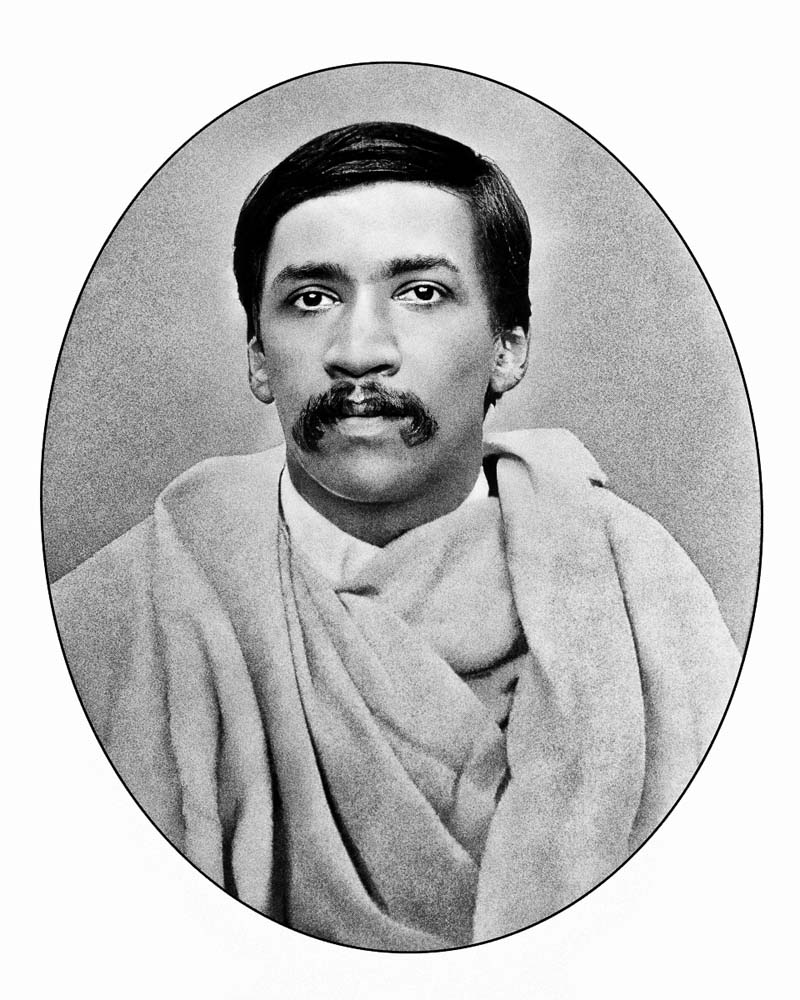
    “The Veda possesses the high spiritual substance of the Upanishads, but lacks their phraseology; it is an inspired knowledge as yet insufficiently equipped with intellectual and philosophic terms. We find a language of poets and illuminates to whom all experience is real, vivid, sensible, even concrete, not yet of thinkers and systematizers to whom the realities of the mind and soul have become abstractions. Yet a system, a doctrine there is; but its structure is supple, its terms are concrete, the cast of its thought is practical and experimental, but in the accomplished type of an old sure experience, not of one that is crude and uncertain because yet in the making. Here we have the ancient psychological science and the art of spiritual living of which the Upanishads are the philosophical outcome and modification and Vedanta, Sankhya and Yoga the late intellectual result and logical dogma. But like all life, like all science that is still vital, it is free from the armoured rigidities of the reasoning intellect; in spite of its established symbols and sacred formulae it is still large, free, flexible, fluid, supple and subtle. It has the movement of life and the large breath of the soul. And while the latter philosophies are books of Knowledge and make liberation the one supreme good, the Veda is a book of Works and the hope for which it spurns our present bonds and littleness in perfection, self-achievement, immortality.

    The doctrine of the Mystics recognizes an Unknowable, Timeless and Unnameable behind and above all things and not seizable by the studious pursuit of the mind. Impersonally, it is That, the One Existence; to the pursuit of our personality it reveals itself out of the secrecy of things as the God or Deva, – nameless though he has many names, immeasurable and beyond description, though he holds in himself all description of name and knowledge and all measures of form and substance, force and activity.

    The Deva or Godhead is both the original cause and the final result. Divine Existent, builder of the worlds, lord and begetter of all things, Male and Female, Being and Consciousness, Father and Mother of the Worlds and their inhabitants, he is also their Son and ours: for he is the Divine Child born into the Worlds who manifests himself in the growth of the creature. He is Rudra and Vishnu, Prajapati and Hiranyagarbha, Surya, Agni, Indra, Vayu, Soma, Brihaspati, – Varuna and Mitra and Bhaga and Aryaman, all the gods. He is the wise, mighty and liberating Son born from our works and our sacrifice, the Hero in our warfare and Seer of our knowledge, the White Steed in the front of our days who gallops towards the upper Ocean.

    The soul of man soars as the Bird, the Hansa, past the shining firmaments of physical and mental consciousness, climbs as the traveller and fighter beyond earth of body and heaven of mind by the ascending path of the the Truth to find this Godhead waiting for us, leaning down to us from the secrecy of the highest supreme where it is seated in the triple Divine principle and the source of the Beatitude. The Deva is indeed, whether attracting and exalted there or here helpful to us in the person of the greater Gods, always the Friend and Lover of man, the pastoral Master of the Herds who gives us the sweet milk and the clarified butter from the udder of the shining Cow of the infinitude. He is the source and the outpourer of the ambrosial Wine of divine delight and we drink it drawn from the sevenfold waters of existence or pressed out from the luminous plant on the hill of being and uplifted by its raptures we become immortal.

    Such are some of the images of this ancient mystic adoration.”

    Sri Aurobindo “Secret of the Veda”

  • Gems of the Grahas: Ruby (Padmanabha mani or manika)   Gem of the Sun (Surya)

    Gems of the Grahas: Ruby (Padmanabha mani or manika) Gem of the Sun (Surya)

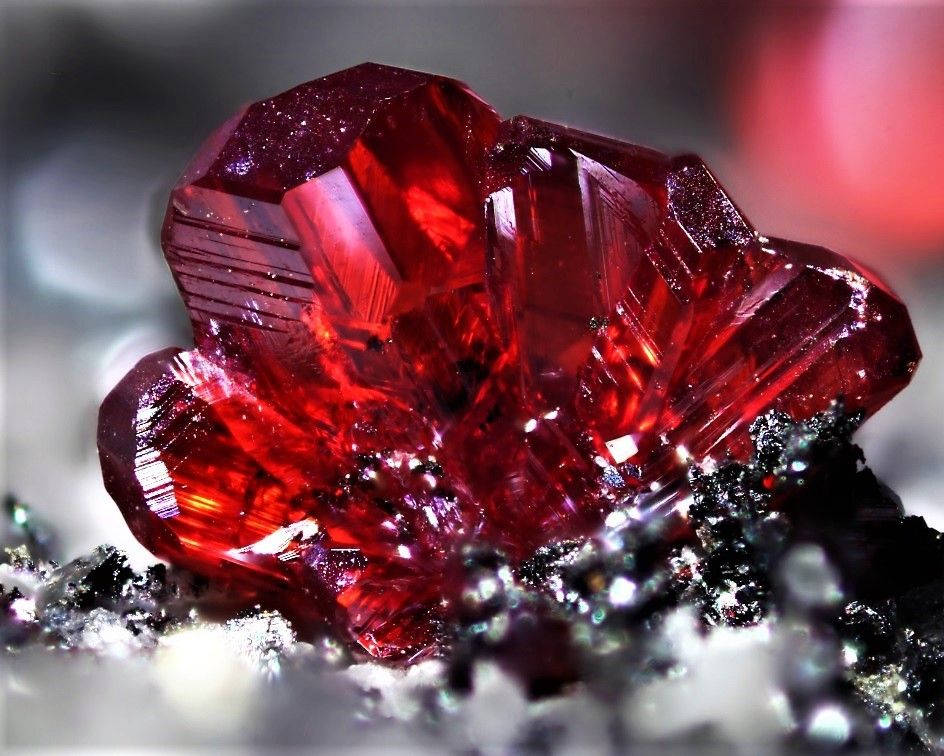
    Gems of the Grahas: Ruby, the Gem of the Sun (Surya)

    Numerology: 2 

    Pitta dosha

    Pacifies Vata and Kapha, may elevate Pitta

    Qualities of Sun: sweet, pungent and heating, stimulating in nature. Pitta prakriti people should observe if pulse becomes elevated, rash or hives develop when wearing Ruby, as this can lead to an aggravation of this dosha.  

    Ruby brings prosperity, longevity and improves agni. It’s rasa (taste) is sweet and pungent, being sweet post-digestion. According to Vasant Lad ” The taste is not evident if one licks the ruby, but if the ruby is made into a bhasma (ash), the taste and action of that bhasma in the body has been observed. The external use of that particular stone, either in the form of a necklace or a ring worn on the ring finger, has a subtle effect on the pulse and the doshas.”

    Sun rules the sign of Leo,the natural 5th house of the Kaal Purush. The 5th house is where the lungs and diaphragm are located is on a physical level. On a larger scale, the 5th house represents our past life merit accumulation and is often called the Bhava of Poorva Punya.  

    According to Ayurvedic Vaidya /Jyotishi Dr. Vasant Lad, Ruby helps with ailments such as poor circulation, anemia, spleen dysfunction, and weak agni. The psycho-spiritual effects of Ruby as described by Vaidya David Frawley: “Ruby strengthens ones sense of self, destiny, leadership, and command. It aids in self-confidence, self-expression, and self-discipline. Generally it helps elevate a person in life, endowing one with the character and will power necessary for great achievements. Ruby can put one in touch with ones soul and higher self (Atman). It can improve meditation, perception and insight, and help promote Self-knowledge and Self-realization. It is particularly good for the Yoga of knowledge (Jnana Yoga), connecting us with the light of consciousness within.”

    Settings: Gold

    Worn on the ring finger or as a pendant over the heart, depending on the birth chart.  

    Gems should be checked according to the birth chart by a knowledgeable jyotishi.

    Copyright Lunar Mysticism Vidhya 2025. Om Namah Shivaya. 

  • Bhoota Shuddhi

    Bhoota Shuddhi

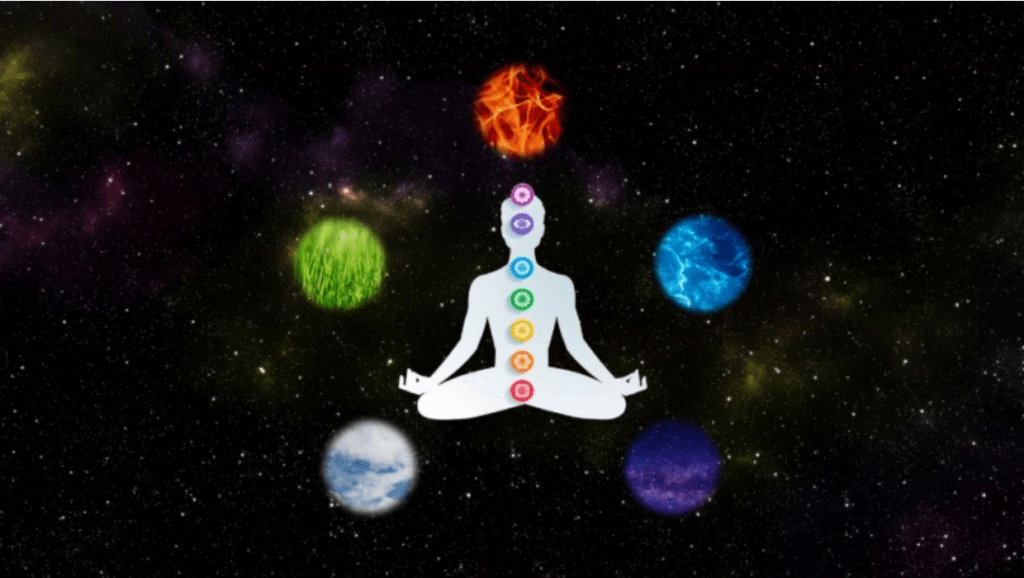
    According to Tantras, Bhutasuddhi is that ritual through which five physical elements of the body become purified and unite in the ceaseless Brahma.

    The Sadhaka should meditate upon the Kundalini Sakti as located in the Muladhara Chakra, thin like a lotus fibra and shining like lightning.  This Kundalini should be awakened from the Muladhara and brought through the Susumna (passing through the Svadhisthana and Manipuraka chakras) to the Anahata chakra located in the Heart. The Jiva in the form of a wick of a lamp situated here should be meditated as taken into the mouth and, piercing the Visuddha and Ajna cakras, has been led to the Sahasrara cakra, located in the Brahmarandhra, which is the house of Supreme Soul. The Sadhaka should, with the Hamsa mantra, merge Kundalini along with the Individual soul into the Superlative Soul.  

    Then, from the sole of the feet to Brahma-randhra, he should meditate on the Five elements with their colors, forms and Bija-mantras. 

    Its method is as follows- {Method #1}

    *Yellow – Square – Bhu Bija: Lam – Earth Element 

    Meditation: soles of the feet up to the knees

    *White – Half-circle – Two Lotuses – Jala Bija: Vam – Water Element 

    Meditation: knees up to the navel 

    *Red – Triangle – Svastika – Agni Bija: Ram – Fire Element 

    Meditation: Navel up to the Heart

    *Smoke – Circle with 6 Bindus – Vayu Bija: Vam – Air Element

    Meditation: from Heart up to the middle of eyebrows

    *Crystal Clear Eye-Catching – Sphere – Akasa Bija: Ham – Sky Element

    Meditation: from middle of the eyebrows up to the Brahmarandhara

    Akasha Ham Crystal

    Vayu Vam Smoke

    Vayu      Vam Smoke

    Agni Ram Red

    Jala Vam White

    Prithvi Lam Yellow

    Earth – Physical elements

    Organs of Activity: anus, feet, vocal chord, genitals and their actions  of grasping and motion

    Sense Organs: nose, tongue, eyes, skin, ears and their actions

    Presiding deities: Brahma, Vishnu, Shiva, Isana and Sadasiva

    Kalas: Nivritti, Pratisuha, Vidya, Santi & Santyatita

    Vayus: Samana, Udana, Vyana, Apana & Prana  

    After thus meditating on the Earth elements the Sadhaka should liquefy the Earth into Water, Water into Fire, Fire into Air, Air into Sky, Sky into Ahamkara (Ego), Ahamkara into Mahat tattva, the Mahat tattva into Prakriti and the Prakriti into the Soul. 

    After that, feeling himself pure and Saccidananda, the Sadhaka should concentrate upon the dark skin toned and thumb-sized embodied Sin located in the left cavity of his abdomen.  Brahmanicide is the head of this embodied sin, theft of gold its hands, drinking wine its heart, defilement of Guru’s bed its waist, contact with the sinners and the like its feet and minor sins its body-hairs. Such an embodied wicked sin, wielding sword and shield with its head upside down, should be meditated on.

    Purascarana Candrika Bhutashuddi: {Method #2}

    “The Sadhaka should meditate that there is a lotus in the heart whose root is Dharma and stalk in knowledge.  Eight kinds of supremacies are its petals and Para-vairaghya is its seed vessel.  It is illuminated by Pranava (Aum).  In its seed vessel is located the Individual Soul bright in form like the wick of a deepak. “

    Meditating thus the Sadhaka should concentrate upon the Kundalini located in the Muladhara.  This Kundalini, sleeping in the Muladhara, should be awakened and, through the pathway of Susumna, be taken along with the Individual Soul to be merged with the Supreme Soul.  For a moment the Sadhaka should experience this state.  Then, through the Kundalini, bring back the Individual Soul from the propinquity of Supreme Soul, establish it again in the heart and then Kundalini brought back to the Muladhara.  

    {Method #3}

    Despite the above two, there is a third method of Bhutashuddhi. In the above two methods we find the experiences of Raja yoga, Bhavana or feeling of Laya Yoga, Sakti of Mantra-yoga and the actions of Hatha-yoga; but in this method there is a beautiful tinge of the power of Mantra and the feeling of the meaning of Mantras.  It undeniably culminates into the Raja-yoga but there is absolutely no Hatha-yoga in it. In this method there is a repetition of the following four mantras with the feeling of their meaning-

    1. Aum paramasivasusumnapathena mula-srngatam allasa allasa jvala jvala prajvala so’ham hamsah svaha.

    2. Aum Bhutasrngatat sirah susumnapathena jivasivam paramasivapade yojayami svaha.

    3. Aum Ram sankocasariram daha daha svaha.

    4. Aum Yam Lingasariram sosaya sosaya svaha.

    Repeating these mantras with a mental feeling of their meaning for a moment with one pointed mind, the body becomes pure and godly. 

    Spirituality is the only medium to know and understand about that unseen 

    beyond worldly power , to whom we know by the name of Ishwar, Allah, Waheguru, Moula, God. Spirituality has many branches. We can achieve our target by any one of its branches.

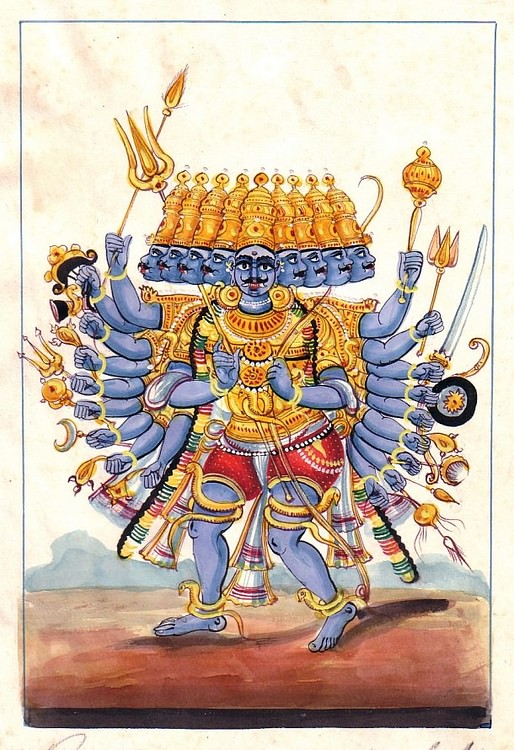
    Ravan Sanhita (Mantra, Tantra and Yantra) “The Science of Mantras” 

  • Prajapati: The Original Progenitor

    Prajapati: The Original Progenitor

    (Excerpt taken from Goswami Kriyananda’s ” A Yoga Dictionary of Basic Sanskrit Terms”)

    Praja – propagation

    Pati – Lord

    A Vedic concept symbolizing the personified forces of nature as a single creative force. Prajapati was later merged into the concept of Lord Brahma.

    The Puranas point out that Prajapati formed living creates out of his own sacrificial offerings to the devas, and when these living creatures were destroyed by the Maruts (the storm devas), they were recreated by Prajapati. The Artha Veda identifies Prajapati’s creative energy with Prana or the vital breath.

    In the Vedic tradition there are 33 devas, but Prajapati is regarded as the 34th devata, symbolizing the totality of these 33. The Samhitas point out that Prajapati as 33 daughters, whom he presented to King Soma.

    Prajapati is the divine counterpart of the earthly sacrificer. He is also “time” which leads to death, so that the sacrificer himself might become death, and by that act, overcome death. According to sri Manu, the horse is sacred to Prajapati, because HE assumed that form when he searched for Lord Agni, who his in the water of the gods.

    Prajapati also means the twelve symbolic great sages, also referred to as the maha-rishis: the mind-born sons of Sri Brahma. Prajapatis were also called Brahma-rishis or Brahma-putras, and as such symbolize the instrumentality of the secondary creation. This concept of evolution begins with the notion of the Self-existent One, called Svayambhu: the unknowable, the unfathomable, who divided his own body and became half male and half female. The female half symbolizes the cosmic potency which was produced from the male Viraj. Svayambhu then called into existence the great sages destined to be the lords of all created beings.