Category: Jyotish

  • Graha Upaya: Remedies for Planets & Planetary Magick

    Graha Upaya: Remedies for Planets & Planetary Magick

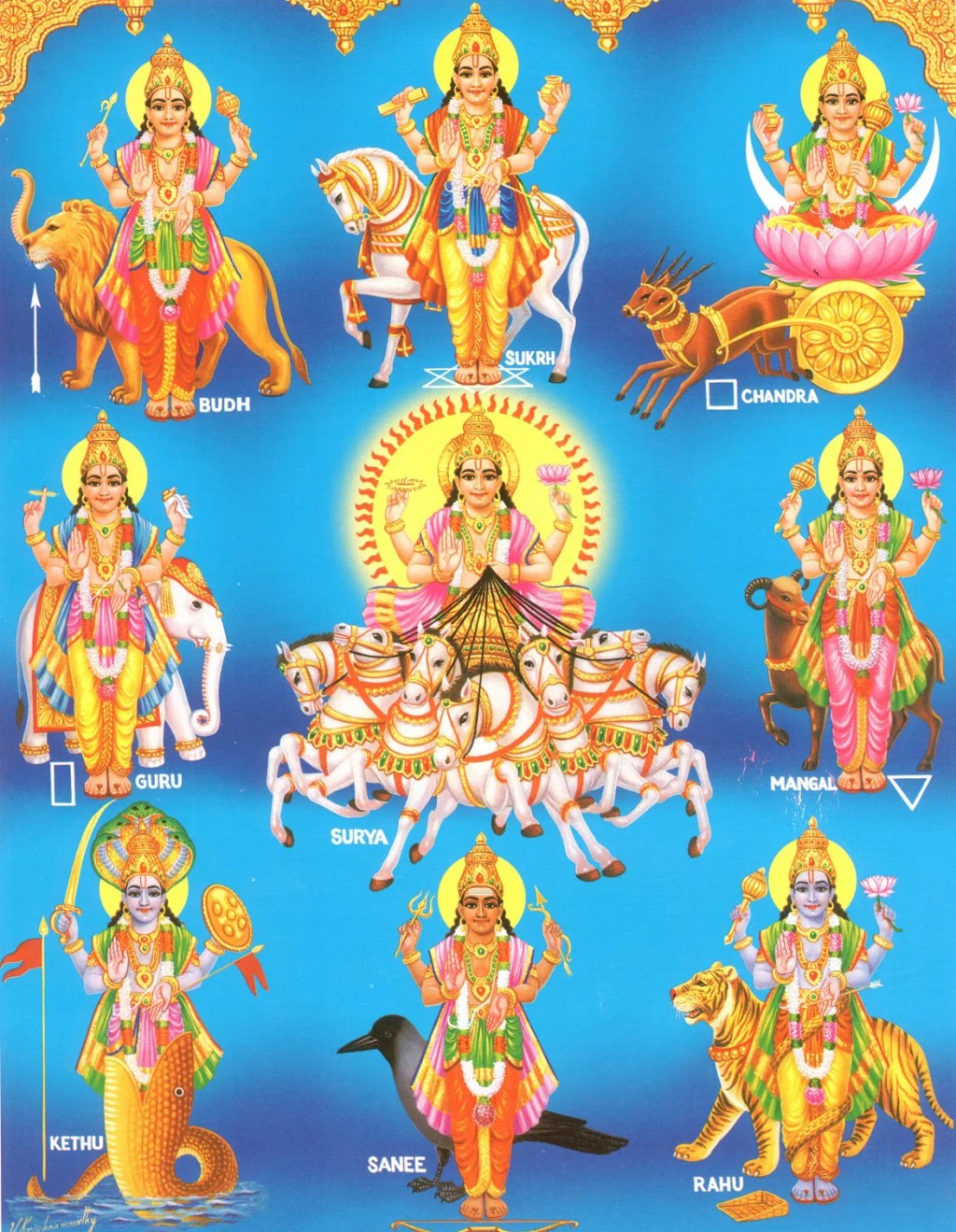
    Jyotish Vidya describes (what we call the Planets) Graha – one who seizes the energy.

    “Brihat Jatak” by Acharya Varahamihira, details the colors of the planets:

    रक्त श्यामो भास्करो गौरेन्दुर्नात्युच्चाङ्गो रक्त गौरश्च वक्रः ।
    दूर्वा श्यामो ज्ञो गुरुर्गौरगात्रः श्यामः शुक्रो भास्करिः कृष्णदेहः ॥ ४ ॥

    rakta śyāmo bhāskaro gaurendurnātyuccāṅgo rakta gauraśca vakraḥ |
    dūrvā śyāmo jño gururgauragātraḥ śyāmaḥ śukro bhāskariḥ kṛṣṇadehaḥ
     || 4 ||

    Sun is Dark Red in Color

    Moon is White

    Mars colors are Red and White

    Mercury is dark colored Durva grass

    Jupiter is yellow colored

    Venus is Dark blue

    Saturn is Black

    (Note: A simplified translation)

    You will find a few variations in the colors of the planets… Most texts will give Venus the color white and Saturn dark blue.

    The Brihat Samhita mentions the following on Gems and Upaya:

    “According to some, gems are the bones of Balāsura and according to others, they are the bones of the Sage Dadhīci. In the opinion of some, gems are various sorts of stones which naturally exist in the earth.

    Twenty-two different sorts of gems (ratna) are mentioned. These are—Diamond, Sapphire, Emerald, Agate, Ruby, Blood-stone, Beryl, Amethyst, Vimalaka, Quartz, Crystal, Moon-stone, Saugandhika (a type of Ruby ), Opal, Conch-shell, Azure-stone, Topaz, Brahmamaṇi, Jyotīrasa, Sasyaka (blue vitriol Copper Sulfate), Pearl and Coral.”

    In various tantric and natural indigenous paths, bones, hide and teeth of animals are used in medicine pouches and amulets. It is not random – usually given by shaman or other healer for specific use charged on an intentionally chosen lunation, based on the nature of the working etc.

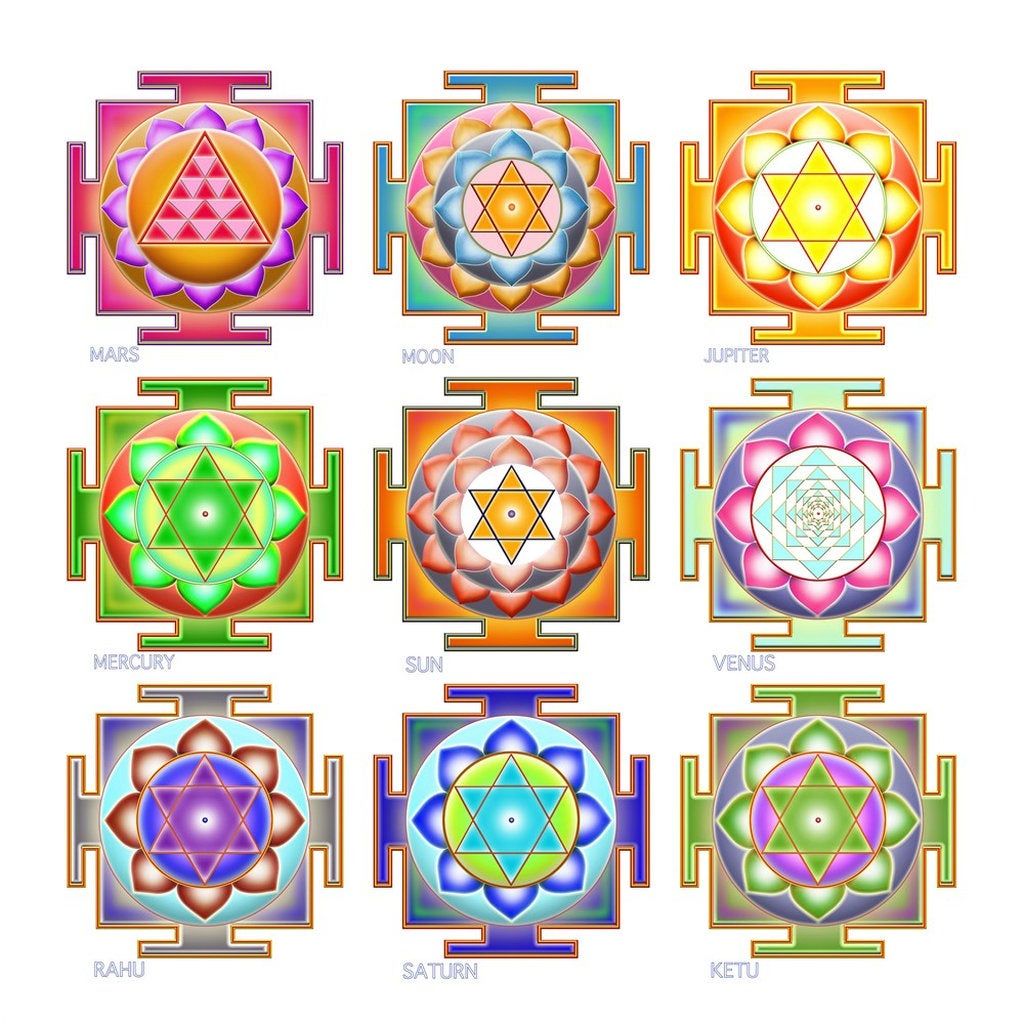
    The Yantras of the Grahas also give us a color palette to harmonize the energy of each Graha. Below is one example.
    Grahas are also associated with the days of the week, and Lord one hour per day and night (changing daily according to the Lord of the day – Varesh). The Vedic week begins with Sunday and ends with Saturn-day.

    Sunday – Ravivar – Lord is Surya (Sun)

    Monday – Somvar – Lord is Chandra (Moon)

    Tuesday – Mangalvar – Lord is Mangal (Mars) said to be co-ruled by Ketu (South Node of the Moon)after dark

    Wednesday – Budhavar – Lord is Budha (Mercury)

    Thursday – Guruvar – Lord is Brihaspati or Guru (Jupiter)

    Friday – Shukravar – Lord is Shukra (Venus) said to be co-ruled by Rahu (North node of the Moon) after dark

    Saturday – Shanivar – Lord is Shani (Saturn)

    When creating planetary magic using colors its important to consider the day of the Planet whose energy you want to work with along with the colors and tattvas (elements). By incorporation of various colors intentionally you are creating an energy field around yourself using the most available everyday items: clothing! This is a great remedy that anyone can try to harmonize transits, malefic combinations etc.

    Simple chant to the Trimurti+Devi and Navgraha:

    Brahma Murari Tripuratakari

    Bhanu Sasi Budhasca Shukraha

    Shani Rahu Ketva

    Bhagavati Kali
  • “What comes after death?” by Swami Vivekananda

    “What comes after death?” by Swami Vivekananda

    What comes after death? All these Vedanta philosophers admit this Jiva is by its own nature pure. But ignorance covers its real nature, they say. As by evil deeds it has covered itself with ignorance, so by good deeds it becomes conscious of its own nature again. Just as it is eternal, so its nature is pure. The nature of every being is pure. 

    When through our good deeds all its sins and misdeeds have been washed away, the Jiva becomes pure again and when it becomes pure, it goes to what is called Devayana. Its organ of speech enters the mind. You cannot think without words.  Whenever there is thought, there must be words.  As words enter the mind, so the mind is resolved into the prana  and the prana into the Jiva.  Then the Jiva  gets quickly out of the body, and goes to the solar regions, this universe has sphere after sphere. This earth is the world sphere, in which are moons, suns and stars. Beyond that there is the solar sphere, and beyond that another which they call the lunar sphere. Beyond that there is a sphere which they call the sphere of lightning, the electric sphere, and when the Jiva goes there, there comes another Jiva, already perfect to receive it, and takes it to another world, the highest heaven, called Brahmaloka, where the Jiva lives eternally, no more to be born or to die.  It enjoys through eternity and gets all sorts of powers, except the power of creation.  There is only one ruler of the universe and that is God.  No one can become God; the dualists maintain that if you say you are God, it is blasphemy.  All powers except the creative come into the Jiva, and if it likes to have bodies and work in different parts of the world, it can do so. If it orders all the gods to come before it, if it wants the forefathers to come, they all appear at its command. Such are its powers that it never feels any more pain, and if it wants, it can live in the Brahmaloka through all eternity. This is the highest man, who has attained the love of God, who has become perfectly unselfish, perfectly purified, who has given up all desires, and who does not want to do anything except worship and love God. 

    There are others that are not so high, who do good works but want some reward.  They say they will give so much to the poor, but want to go to heaven in return. When they die what becomes of them? The speech enters the mind, the mind enters the Prana, the prana enters the Jiva, and the Jiva gets out, and goes to the lunar sphere, where it has a very good time for a long period.  There, it enjoys happiness, so long as the effect of its good deeds endures.  When the same is exhausted it descends, and once again enters life on earth according to its desire.  In the lunar sphere, the Jiva becomes what we call a god, or what the Christians or Mohommedans call an angel.  These gods are the names of certain positions; for instance, Indra, the king of the gods, is the name of a position; thousands of men get to that position.  When a virtuous man who has performed the highest of Vedic rites dies, he becomes a king of the gods; by that time the old king has gone down again and become man.  Just as kings change here, so the gods, the Devas, also have to die. In heaven they will all die. The only deathless place is Brahmaloka, where alone there is no birth and death.  So the Jivas  go to heaven, and have a very good time except now and then when the demons give them chase.  In our mythology it is said that there are demons who sometimes trouble the gods.  In all mythologies you read how these demons and the gods fought, and the demons sometimes conquered the gods, although many times it seems, the demons did not do so many wicked things as the gods.  In all mythologies, for instance, you find the Devas fond of women. So after their reward is finished, they fall down again, come through the clouds, through the rains, and thus get into the human body, when the grain or plant is eaten by men.  The father gives them the material out of which to get a fitting body.  When the material suits them no longer, they have to manufacture other bodies.  Now there are the very wicked fellows, who do all sorts of diabolical things; they are born again as animals, and if they are very bad, they are born as very low animals, or become plants or stones.  

    In the Deva form they make no Karma at all; only man makes Karma.  Karma means work which will produce effect.  When a man dies and becomes a Deva he only has a period of pleasure, and during that time makes no fresh Karma; it is simply a reward for his past good Karma.  When the good Karma is worked out, then the remaining Karma begins to take effect, and he comes down to earth.  He becomes man again, and if he does very good works and purifies himself, he goes to Brahmaloka and comes back no more.

    The animal is a state of sojourn for the Jiva evolving from lower forms.  In the course of time the animal becomes man.  It is a significant fact that as the human population is increasing, the animal population is 

    decreasing.  The animal souls are becoming men.  So many species of animals have become men already.  Where else have they gone? 

    In the Vedas there is no mention of hell.  But our Puranas, the latter books of our Scriptures, thought that no religions could be complete unless hells were attached to it, so they invented all sorts of hells. In some of these, men are sawed in half, and continually tortured, but do not die.  They are continually feeling intense pain, but the books are merciful enough to say that it is only for a period.  Bad Karma is worked out in that state and then they come back to earth, and get another chance.  So this human form is the great chance.  It is called the Karma-body, in which we decide our fate.  We are running in a huge circle, and this is the point in the circle which determines the future. 

    -from a speech given in 1893 at the Parliament of Religions in Chicago on “The Philosophy of Hinduism”

  • 2024 News!

    2024 News!

    I am happy to announce that my research and studies in the field of Jyotish have culminated in the selection as a presenter for this years virtual Maharishi Parashara Conference! The conference will take place November 21-24 2024, featuring world renowned astrologers alongside newcomers like myself. My presentation “Venus: Love, Shamanism and Life Force” will showcase my research into planet Venus including new insights and never-before discussed topics in the field of Jyotish.  

    Use code: Venus2024 for a 10.8% Discount.

    THURSDAY
     

    (8-9 AM): Christina Escamilla. Venus, Love, Shamanism, and Life Force


    After contemplation and meditation on what I can offer to the field of Jyotish, I have been guided to share some of my insights into Venus!
    1. Lord Shurkracharya: his origin story, sanjeevani and healing, the hanged man story in tarot and of Odin
    2. Venus and the connection to the (rarely spoken of) fields of tantra, shamanism and Santan Dharma and how they all manifest uniquely in our birth charts and in culture.
    3. Venus is often depicted as a planet that is associated with Love but is also a karaka of Shukra and life-force (ojas)
    5. How to look at Venus in a chart, insights into Venus dasha and Venus retrograde!
    4. Simple remedies that students of jyotish and non-practitioners alike can find useful in their lives.
    6. Sample charts of Venus that illustrate the different energies that Venus represents

    To register for the conference please visit: https://www.parasharaconference.com/

  • The Fixed Stars

    In Vedic Astrology, we use the fixed stars to study our planetary placements in the Rashis (Signs). The Nakshatras are located in outer space, among the stars. They are often referred to as “lunar mansions”, because the moon visits each one as it moves through the sky, usually staying for 1.5 to 3 days. According to the ancient texts, the moon had 27 wives who were called the Nakshatras, Rohini being his favorite. Nakshatras are often translated into English as “asterisms”, meaning a group of stars that form various patterns in the night sky, from a small to large group forming simple to complex shapes.