I was recently interviewed by one of my Jyotish teachers: Ksanati Jyotish! We previewed my lecture at this year’s Maharishi Parashara Conference: Venus, Love, Shamanism and Life Force. If you would like to attend this years conference please visit: https://www.parasharaconference.com/
Enter code: Venus2024 for an extra 10.8 % discount on single lectures, day and full lecture series. The Maharishi Parashara Conference is being held virtually this year starting Thursday November 21, 2024. I have the pleasure of being the first presenter at 5am PST 8 am EST among many of the world’s finest in the world of Jyotish. This year’s focus is the next generation of up and coming Jyotishas! I look forward to seeing you all there.
When you begin your journey with Ayurveda, you may sometimes be given herbs by your Practitioner as part of your healing regimen. Herbs are used in Ayurveda to help bring you back into balance and discontinued after the desired results are achieved, after careful monitoring and sometimes a fine tuning of dose. The use of herbs in Western Culture is discounted as a true form of healing, often times there is a fear tactic used by doctors and print media to convince people that herbs are not safe, full of heavy metals or just plain not capable of the healing that pharmaceuticals provide. Herbs and pharmaceuticals provide completely different forms of healing and also impact the body, mind and spirit of the individual.
Herbs vs Pharmaceuticals… the biggest factor in safety is the impact on the body. Most herbs used in Ayurveda have no side effects, but should only be taken under the guidance of a professional, as there are specifics for using certain plants. There are recommended uses, as well as cautions, for pregnancy, older clients, children, individuals taking pharmaceuticals and contraindications to be considered. When it comes to pharmaceuticals, their use can impair motor function, suppress functions of the body and even damage important organs like the liver, colon, stomach and affect the nervous system.
Ayurveda considers the needs of each individual and that everyone makes the choices for the health that make sense for them. The use of herbs, drugs and pharmaceuticals should be disclosed to the practitioner during the initial consultation. Below are a few tips I find helpful to consider when embarking on a new herbal journey.
Digestion- herbs will behave differently based on their energetics and the strength of digestion of the individual.
Diet- foods consumed impact the innate ability to maintain health and influence the development of the tissues.
Lifestyle- based on your life demands, some herbs can be recommended in their powder form taken with water if time allows vs the capsule form.
Availability- some herbs have limited availability, this should be considered when sourcing. For the best results, the herb should be taken in the same form during treatment, for example, if you start with the powdered form continue with that form; some people may find that they prefer the powdered form over the leaf or stem infused in a tincture.
Allergies- Herbs are plants lets not forget, allergies to certain herbs exist and should be considered when choosing an herb.
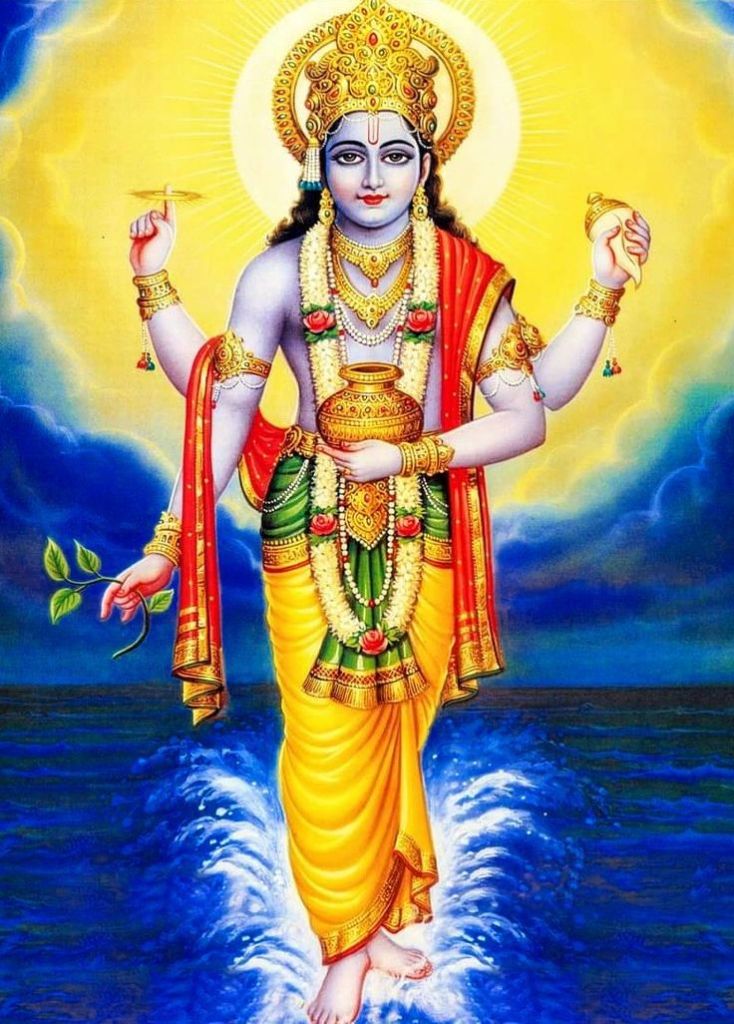
Lord Dhanvantari, the god of Ayurvedic medicine and incarnation of Vishnu, emerged from the cosmic ocean during the Samutramanthan (churning of the cosmic ocean). The Devas and the Asuras decided to band together to churn the cosmic ocean in order get to the Amrit, the divine nectar of immortality, that was at the bottom. According to PubMed article PMID: 12572586:
“The original conception of Ayurveda in its entirety is essentially linked to Dhanwantari who is considered as God of Hindu Medicine. Dhanwantari is considered a mythical deity born with ambrosia in one hand and Ayurveda on the other at the end of the churning of milk ocean. He reincarnated himself in the Chandra dynasty. He was born to King Dhanwa, learnt Ayurveda from Bharadwaja. His great grandson Divodasa was also known as Dhanwantari, but was specialized only in surgical branch of Ayurveda. Sushruta, is said to have learnt the art of science of surgery from Divodasa Dhanwantara.”
Much of what is practiced across the globe as modern medicine, owes its roots to Ayurveda, mostly to Vaidya Sushruta, who was the first to perfect surgery. Sushruta the “Father of plastic surgery and brain surgery” was skilled in plastic surgery and is credited for developing the procedures which later became surgery. This legacy was documented in The Sushruta Samhita and became part of the medical trilogy Brihat Trayi, which is also includes the Charaka Samhita and Ashtangha Hridayam. (more to come on these subjects in future episodes of the podcast & blog)
I give some more insights into Lord Dhanvantari on the Tishya Ayurveda podcast. Link below!